Can I paste client transcripts into ChatGPT or another AI assistant?
Not on a personal plan, even with its settings changed, because a coaching transcript is your client's personal data. Paste it into a personal account of ChatGPT, Claude, Gemini, Copilot or any other AI assistant, and you hand it to a company that applies its own privacy policy to it. There is no data processing agreement between you and that company.
The case that shows why is public. On 2 September 2025, MIT Technology Review reported on clients who found out their therapists were using ChatGPT. One client saw the therapist paste session content into ChatGPT during an accidental screen share.
A BetterHelp client, Brendan Keen, whose therapist admitted using AI in replies, described "an acute sense of betrayal." Those were therapists, not coaches. Coaching rests on the same promise of confidentiality.
Counselling has already answered the question. The good practice guide of the British Association for Counselling and Psychotherapy (BACP) says: "Don't upload identifying client information to an AI system."
In our webinars, coaches ask exactly this: "I already have my own prompts. Why not paste my transcript?" The rest of this article is the answer, deepest on ChatGPT and Claude, and the same questions apply to any assistant.
What happens to a transcript you paste into an AI assistant?
On a personal plan, your chat can be used to train the company's models unless you switch that off, and a deleted chat takes up to 30 days to leave ChatGPT's or Claude's systems. OpenAI's help page says "data sharing is enabled by default". Anthropic's consumer terms let it train on your chats "unless you opt out of training through your account settings".
Deleting does less than it sounds. OpenAI says it removes deleted personal data within 30 days, with exceptions for safety and legal reasons. Anthropic deletes a deleted chat from its back end within 30 days, and may keep data longer to enforce its usage policy or meet legal requirements.
Claude has a longer memory when training is allowed. It may keep your chats in de-identified form for up to 5 years in its training pipelines, and switching training off later does not take them out of models already trained.
Rating is a separate door. Rate a reply with a thumbs up or down and Anthropic keeps the data behind that rating for 5 years, under a rule of its own.
Gemini adds people. Google says that even when your settings do not allow training on your chats, it still uses them to respond and to protect its services, "including with help from human reviewers".
With Gemini History off, future chats are still saved for around 2 months. Reviewed feedback, with the conversation it came from, can be kept for up to 3 years, disconnected from your Google Account.
In the EU, OpenAI's privacy policy names OpenAI Ireland Limited as the controller responsible for processing your personal data. A controller decides for itself what happens to the words. A processor, the role GDPR Article 28 sets out, acts only on your documented instructions under a contract.
In 2023 one Samsung engineer pasted source code into ChatGPT, and another shared a meeting so ChatGPT could write the minutes. Samsung then banned staff from using generative AI tools, as Fortune reported on 2 May 2023.
On 20 March 2023, a bug in an open-source library let some ChatGPT users see the titles of other users' conversations. OpenAI's own post-mortem adds that the first message of a new conversation may also have been visible.
None of this makes the tools reckless. It makes a personal plan a poor place for somebody else's confidences.
Is a transcript still personal data once you take the names out?
Yes, usually. GDPR Recital 26 treats data that could be attributed to a person with additional information as personal data, and only data made anonymous, so that the person is no longer identifiable, falls outside the law. Taking out a name is not anonymising.
A coaching transcript carries the employer, the role, the family, the places and the story itself. Recital 26 asks you to weigh all the means reasonably likely to be used to identify the person. Anyone who knows the client, or the company, will read who it is.
What a client says about their health, sex life or religion can count as special category data under Article 9 of the GDPR, which carries stricter rules. Coaching sessions wander into exactly those subjects.
This is not legal advice. It is a reason to read the settings below before your next paste.
Which settings protect what you paste?
The training switch, Temporary Chat or Incognito, memory and ratings. The picture below shows what each plan does with what you paste.
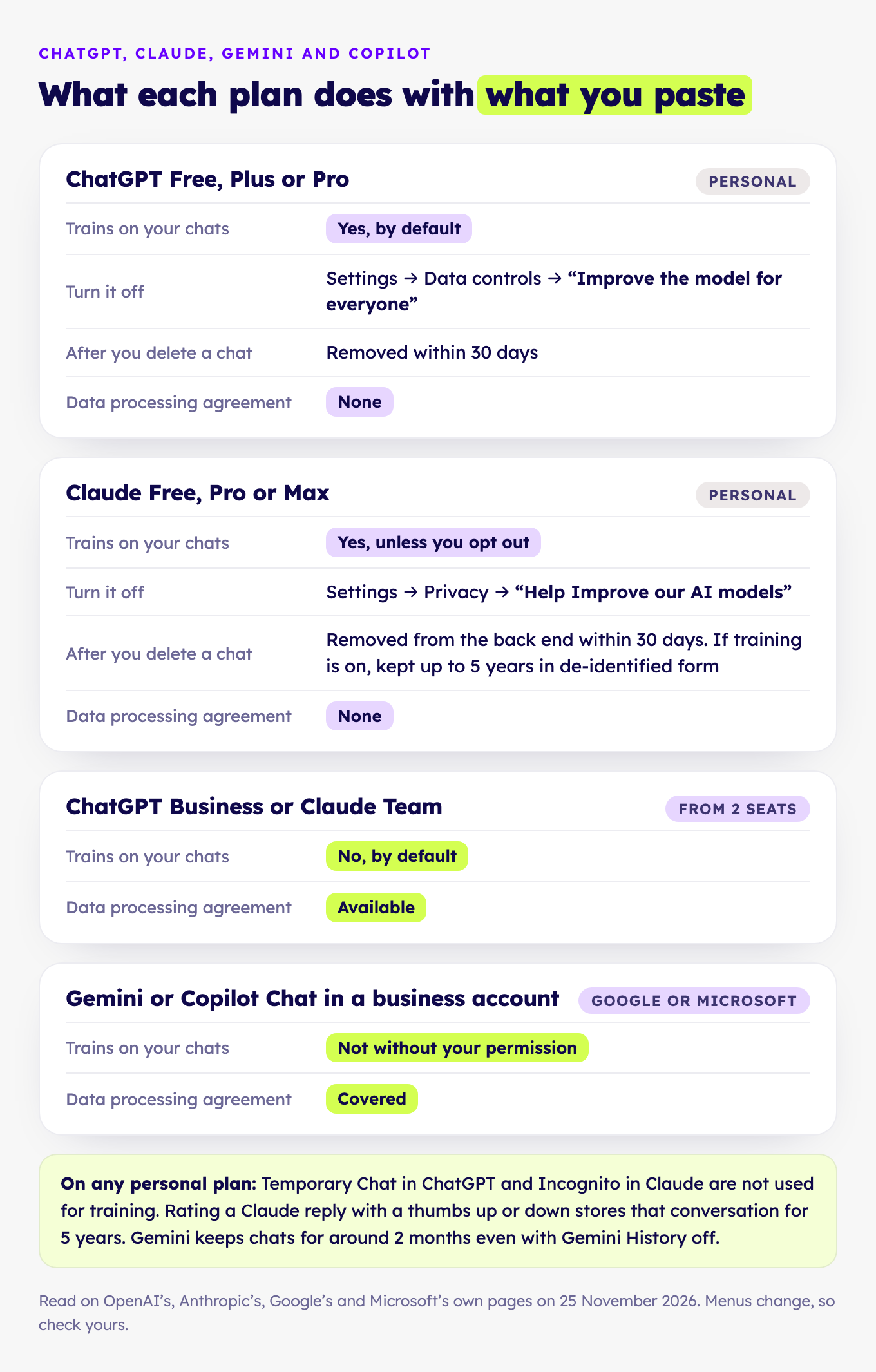
These are the switches, each read on the vendor's own help page on 25 November 2026:
- ChatGPT training. On the web: Settings → Data controls → turn off "Improve the model for everyone", then select Done.
- Claude training. Settings → Privacy → the "Help Improve our AI models" toggle. Anthropic's page covers Free, Pro and Max.
- ChatGPT Temporary Chat. It is not used to improve OpenAI's models while it stays temporary, and OpenAI may keep a copy for up to 30 days for safety. Save the chat and your model-improvement setting applies again.
- Claude Incognito. Incognito chats are not used to improve Claude, even with training switched on.
- ChatGPT memory. Settings → Personalization → Memory. Deleting a chat does not necessarily delete a separate saved memory made from it.
- Claude ratings. Never rate a chat that holds client material.
- Gemini. Turn off Gemini History in your Google Account. Chats are still kept for around 2 months.
- Copilot. Microsoft's enterprise data protection covers Copilot as used by organisations, so Copilot on a personal Microsoft account works like any other personal plan.
The business plans, ChatGPT Business and Claude Team, add no training by default and a data processing agreement. ChatGPT's pricing page says "Business plans are available starting at 2 users", and Claude Team starts at 2 seats as well. A practice of one cannot buy either alone.
The assistants inside business email accounts are a different case. If your practice runs on a Google Workspace or Microsoft 365 business account, Gemini and Copilot Chat work under that account's terms when you are signed in with it.
Google says Workspace "does not use customer data for training models without customer's prior permission or instruction", and your prompts fall under its Cloud Data Processing Addendum. Microsoft says Copilot used by organisations is covered by its Products and Services Data Protection Addendum, "with Microsoft acting as a data processor".
Settings lower the risk. They do not give you a contract.
The same applies when you connect an AI assistant to a coaching tool, ours included: what it reads lands in your assistant's account, under that account's settings.
What do the coaching codes ask of you?
They ask for the strictest confidentiality and for records kept safe under the law, whatever tool holds them. ICF's Code of Ethics, in effect from 1 April 2025, asks in 2.1 for "the strictest level of confidentiality". Standard 2.4 asks you to maintain, store and dispose of records, electronic files included, in a way that promotes confidentiality, security and privacy and complies with applicable laws.
Standard 2.5 says your ethical and legal obligations apply directly and through any technology system you use, and it names artificial intelligence.
The Global Code of Ethics for Coaches, Mentors and Supervisors, which EMCC and the Association for Coaching have signed, asks for the same. It names the data protection law of your client's country.
On 22 October 2026, AC, EMCC Global and ICF announced they are working together on responsible AI practice in coaching. They stress "the importance of client protection, privacy and confidentiality" and give no rule on AI assistants yet.
No code names AI assistants, so the general standards decide. ICF's standard 2.2 asks for "a clear agreement about what information is exchanged" and how it is exchanged among all parties involved. The company behind the assistant is one more party, so your client agrees before you paste.
What do you get from your own prompt, compared with a coaching tool?
A summary instead of evidence, a copy-and-paste routine instead of a record, and a privacy policy instead of a contract.
Output. A general AI assistant returns a summary of what was said. A coaching-specific tool reads the session against a competency framework, quotes each moment with its timestamp and tracks it across sessions.
Process. With your own prompt you paste and re-prompt every time. Nothing carries across clients, and nothing your mentor coach or supervisor can open.
Security. A personal AI assistant account comes with a privacy policy. A coaching tool can come with a contract.
At Wundamental, recordings and transcripts are stored encrypted in Germany, with a backup copy in Sweden. An AI provider in the USA reads the text of the session for the analysis, never the audio, and names in the session still reach it.
We never train AI models on session data, and our AI provider's terms say it does not train on what we send. A data processing agreement is included.
When is it fine, and when is it not?
It is fine for your own practice sessions, role-plays with fellow coaches who agreed, your own reflective notes with no client detail, and generic questions about how to coach.
It is not fine on a personal plan for an identifiable client transcript, for anything touching health, sex life or similar, or for a sponsor's or employer's confidential business.
On a business account with a data processing agreement, the plan stops being the problem. What remains is your client's agreement and the law of their country.
Keep identifiable client transcripts out of any personal AI assistant, and turn its training off today for everything else.
Common questions
Can I ask my client for consent and then paste?
Consent lets your client decide, and asking is the right first step. It does not give you a contract with the company behind the assistant, so the plan's settings still decide what happens to the words. Tell your client which tool you would use and what its settings do before you ask.
Is the API safer than the chat app?
It is a different product with different terms. OpenAI says API data is not used for training by default, may be kept up to 30 days to identify abuse, and that it can sign a data processing addendum. Someone has to build the tool that calls it, and that tool then holds your client's words too.
Does a paid personal plan change any of this?
No. Paying changes your limits, not the terms. ChatGPT Plus and Pro, and Claude Pro and Max, are personal plans with the training defaults described above and no data processing agreement.
Sources
- Therapists are secretly using ChatGPT. Clients are triggered.
- BACP AI good practice guide
- Data controls in ChatGPT | OpenAI Help Center
- Temporary chat in ChatGPT | OpenAI Help Center
- Memory in ChatGPT | OpenAI Help Center
- Privacy policy | OpenAI
- EU Privacy Policy at OpenAI | OpenAI
- Enterprise privacy at OpenAI | OpenAI
- Plans and Pricing | ChatGPT
- Consumer Terms of Service | Anthropic
- How do I change my model improvement privacy settings? | Claude Support
- How long do you store my data? | Anthropic Privacy Center
- Can you delete data sent via Claude? | Anthropic Privacy Center
- Is my data used for model training? | Anthropic Privacy Center
- Commercial Terms of Service | Anthropic
- Plans & pricing | Claude by Anthropic
- Samsung threatens to fire employees that leak data to ChatGPT
- March 20 ChatGPT outage: Here's what happened
- Gemini Apps Privacy Hub - Gemini Apps Help
- Generative AI in Google Workspace Privacy Hub | Google Workspace Help
- Enterprise data protection in Microsoft Copilot and Microsoft Copilot Chat | Microsoft Learn
- Recital 26 GDPR: Not applicable to anonymous data
- Art. 9 GDPR: Processing of special categories of personal data
- Art. 28 GDPR: Processor
- ICF: Code of Ethics
- Global Code of Ethics for Coaches, Mentors and Supervisors (V4, updated December 2025)
- AC, EMCC Global and ICF Global collaborate to shape responsible AI practice in coaching